Driving organisational change towards robust design ethics
Introduction
How I led the Ministry of Justice (MOJ) to make design ethics practical and essential, over six years of persistent, patient work. This is government, which doesn’t exactly move quickly on these kinds of matters.
- Organisation:
- Ministry of Justice
- Sector:
- Public
- Timeframe:
- 2021 to present
- My role:
- Project lead, subject matter expert, UX Designer
- Responsibilities:
- Defining the approach, delivering talks, running cross-gov ethics community, designing and iterating the ethics review, writing guidance, lobbying GDS and MOJ service standards teams
The problem
People tend to interact with the justice system at some of the most difficult times in their lives. Many of those people are vulnerable and have enough to worry about already. As such, I believe that we should spend more time thinking about how people could be unintentionally harmed as a consequence of our services. These harms could be physical, psychological, or social.
We should also spend more time thinking about how our services might impact society more widely as well as the environment.
Objectives
- Make design ethics understandable and non-intimidating.
- Create a tool that will help teams reflect on the ethics of their services.
- Build a governance process to drive take-up, because no one voluntarily does extra work that nobody is asking for.
Starting the conversation
In 2021, The Social Dilemma had just come out and design and tech ethics was becoming a hot topic. Inside government, though, the GOV.UK Service Standard made no explicit mention of ethics and offered little robust guidance to support it. I’m a philosophy nerd and was already writing a philosophy blog in my spare time, so I got together with a few colleagues who felt the same way. We believed the Service Standard needed more robust guidance and an explicit mention of ethics.
We quickly realised the gap was bigger than missing guidance. Many people didn’t really know what ethics is, let alone what design ethics means in practice, and the topic felt intimidating. Even people who cared had no obvious way to act on it. Before we could build anything, I needed to make ethics approachable.
I started by writing about it, and did some work to draw the boundary between good design and ethical design, so people could see what ethics adds rather than assuming it was just another word for good practice.
I wrote some blog posts
-
Good design vs ethical design
I have recently been doing work on design ethics at the Ministry of Justice for the Office of the Public Guardian. I’m currently exploring what…
-
Ethics in design: What is ethics?
In recent times, ethics has become something of a buzzword in the tech industry, and for a good reason. Bad design decisions can lead to devastat…
I gave some talks
I then gave a number of talks across MOJ to start educating people and to make ethics a normal part of the conversation.
I built a community
Ethics work can feel lonely, and I knew other government departments were wrestling with the same questions. I started a cross-government Slack channel called #service-ethics, where people from different departments could chat about all things ethics and we could share events.
I also started a monthly cross-government event where we invited guest speakers and discussed the approaches that different departments were experimenting with. It gave people a place to share what was working, compare notes and borrow from each other, and it gave the work a wider footing than a single department.
I assembled a team
I recruited a researcher, a content designer and a delivery manager, and found someone from senior management to champion and promote the work. The team started brainstorming to figure out what we’d need to deliver to drive adoption and sustained change.
We created a tool
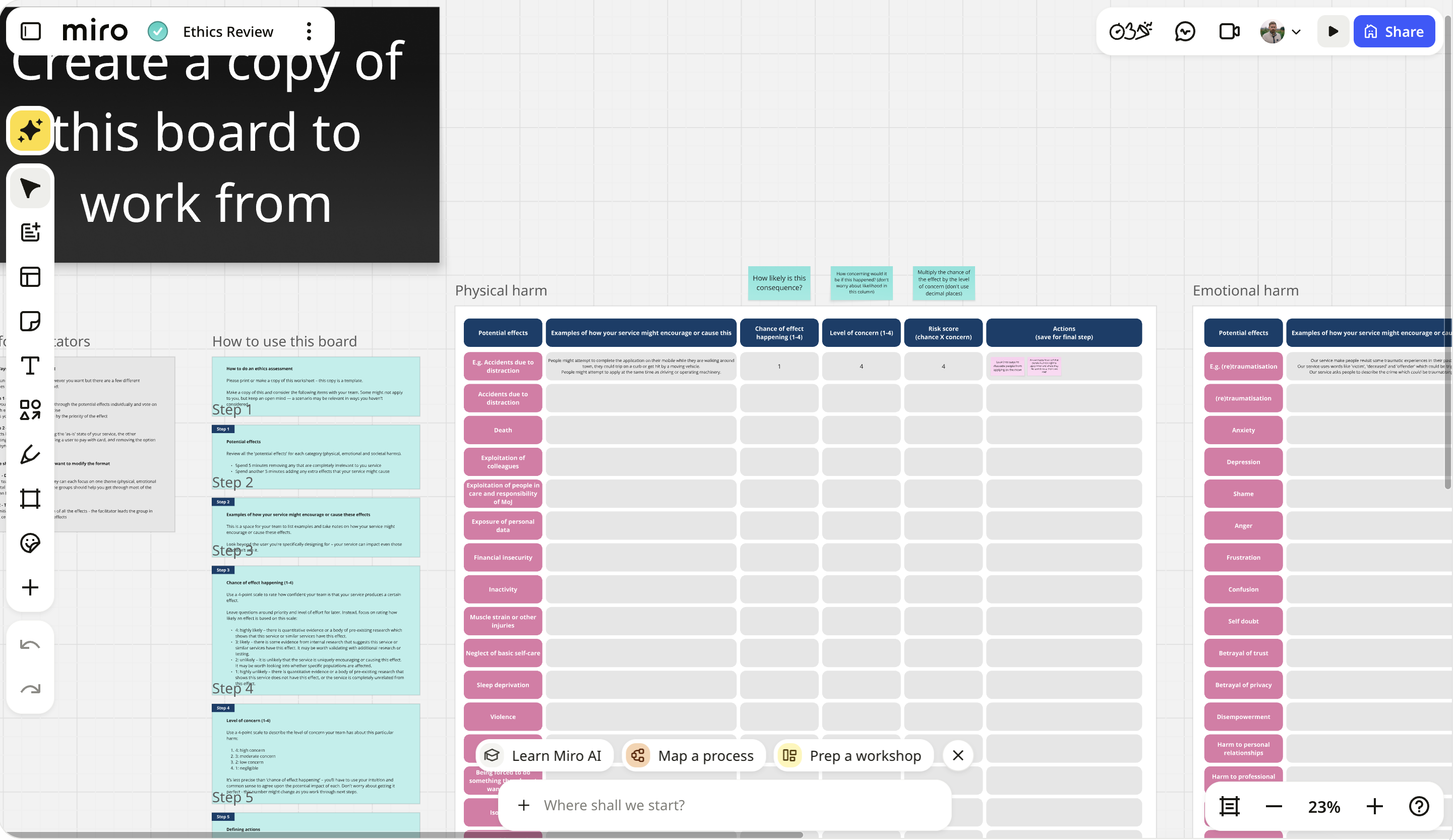
The first thing we needed was a tool. A key objective was to make ethics practical, so we needed to find a way of translating a load of abstract philosophical principles into actionable steps. Rather than reinvent the wheel, we looked at what was already out there and found a workshop that Spotify had created. We amended the content to make it more applicable to MOJ and named it the “ethics review”.
We tested it with a handful of teams, watched where people struggled, and iterated to make it easier to use. That gave us a tool that worked. It also exposed a new problem: who was going to voluntarily do extra work that no one was asking for? To drive take-up, we needed some form of governance around it.
How to assess whether your service is ethical
Here at the Ministry of Justice (MOJ), myself and a group of User Centred Design professionals have been exploring how to make ethics a practical part of the design process.
I made the case for a standard
I decided that ethics guidance belonged in the GOV.UK Service Manual, and that ethics should be included in the Service Standard, either as a new point or incorporated into the existing 14. That would make ethics part of how every government service is assessed, rather than a nice-to-have.
I met with the Government Digital Service (GDS) / Cabinet Office on a number of occasions to push for adoption. They were supportive but lacked the resources to take it on at the time. Their advice was to trial it in MOJ as an experiment and come back once we had some learnings. It wasn’t the answer I’d hoped for, but it gave us a clear route forward.
We created a guidance site
To follow that advice, we drafted content for an MOJ ethics service standard and guidance for how to meet it. This opened up a conversation about where the best place for this guidance to live would be. We eventually decided that the MOJ design system was the most appropriate place, as it was open source and a resource that product teams already used regularly.
We carried out a couple of rounds of usability testing to make sure people understood the guidance and knew what they needed to do, and iterated accordingly.
This work is available on the MOJ design system.
MOJ service standards
Around this time, the MOJ Service Standards team was working on additional standards that MOJ needed, including sustainability and business readiness, and was looking for somewhere to publish them. This was a timely opportunity to package up our ethics work alongside them. This way, all digital teams in MOJ would need to evidence that they’d met the ethics standard as well as all the others.
Trialling it in MOJ
We put all of this to the test in the context of a handful of service assessments. We identified a few teams who were willing to participate and had work that needed ethical consideration.
In a briefing document, we told them to read the guidance on the MOJ design system. We wanted to see if people understood the guidance and knew what actions were expected of them without us giving them specific instructions. Those teams showed up prepared and ready to answer the questions that we had outlined in the guidance. They also came with a completed ethics review and were able to talk about what it had brought up for them.
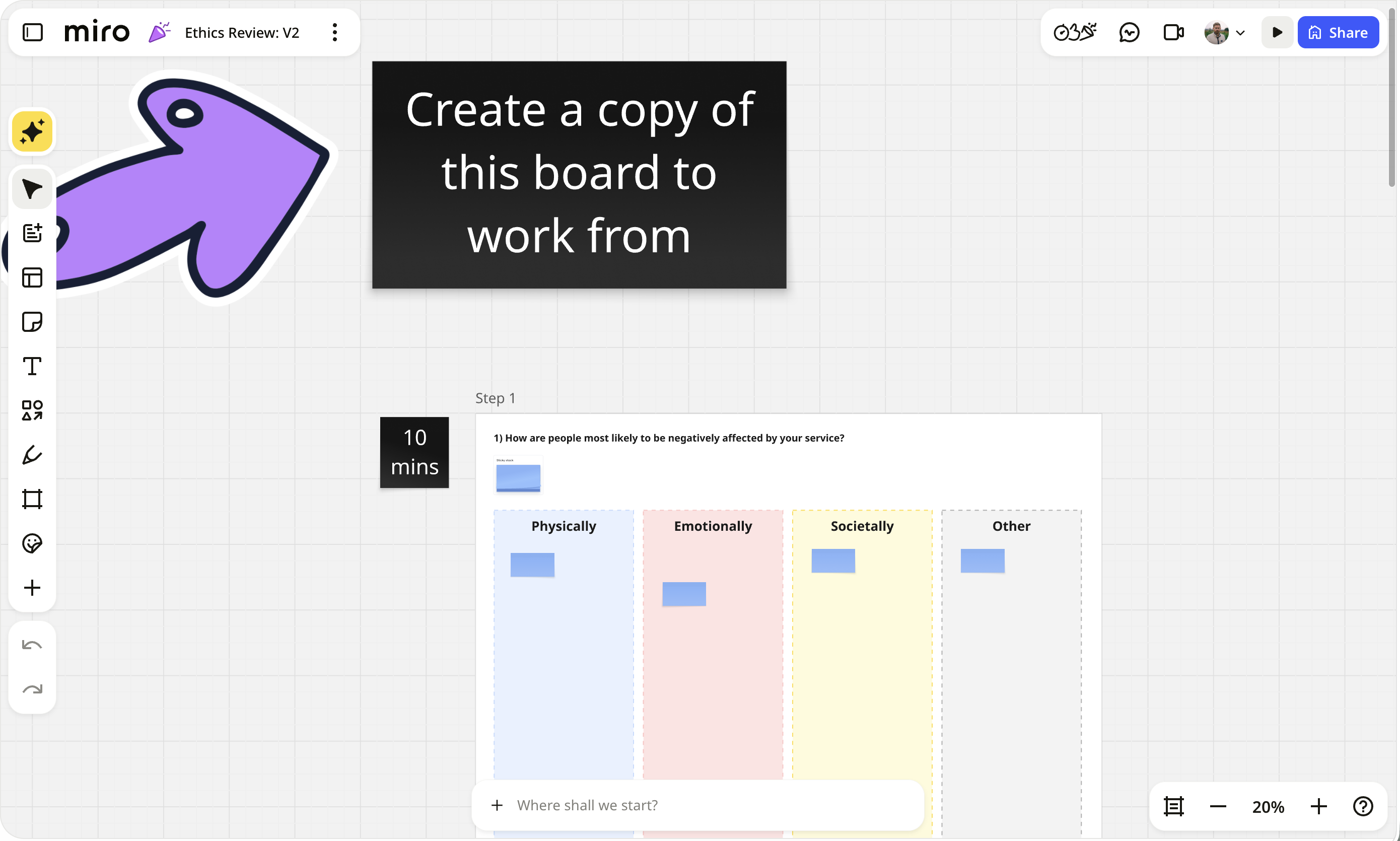
As more teams ran the ethics review, I collated further research and used it to redesign the format. Sessions could now be tailored to different teams, so they could focus on what was relevant to them and save time on what wasn’t. This made the review easier to justify to busy teams.
Bringing it all together
Following the trial, I made the case that our ethics guidance should be part and parcel of the wider standards work, with everything sitting together on the same guidance site. That placed ethics alongside the other standards teams already had to meet, rather than leaving it as a separate initiative.
I also pushed for the guidance to be open and accessible to people outside MOJ, because this was cutting-edge work and other organisations could learn from it and build on it.
Outcomes
Over six years, MOJ has become a more ethically aware and mature organisation. The ethics review has helped people think more thoroughly about inclusion, risks to individual safety, psychological harms and societal consequences. The ethics guidance has made design and tech ethics more intelligible and actionable.
Most significantly, the ethics service standard will become a mandatory part of service assessments from January 2027.
Reflection
Culture change in government is slow, but it responds to persistence, practical tools and the right governance hooks. Making ethics approachable got people interested, and making it a standard made it stick.