Designing an inclusive identity verification journey
Introduction
In an ever-changing digital landscape, how might someone prove their identity online?
- Organisation:
- Ministry of Justice
- Sector:
- Public
- My role:
- UX Designer
- Responsibilities:
- Workshop facilitation, interaction design, prototyping
- Phase:
- Alpha
Discovery
To kick off this project, the team did some discovery work into existing ID patterns. The NHS and Post Office EasyID apps both use patterns that we were able to learn from.
NHS app


Easy ID app


Interaction design
I sketched a number of ways to prove identity. The first iteration had three options that we could begin testing with users:
- a passport check
- a driving licence check
- a bank account check (via open banking)

From there we wanted to aim for a more inclusive set of options catering to both online and offline scenarios. We also wanted to include options for people of various levels of digital literacy, so we added:
- a Universal Credit account check
- a Government Gateway account check
- knowledge based verification
- get someone to vouch for your identity
- directions for offline identity verification
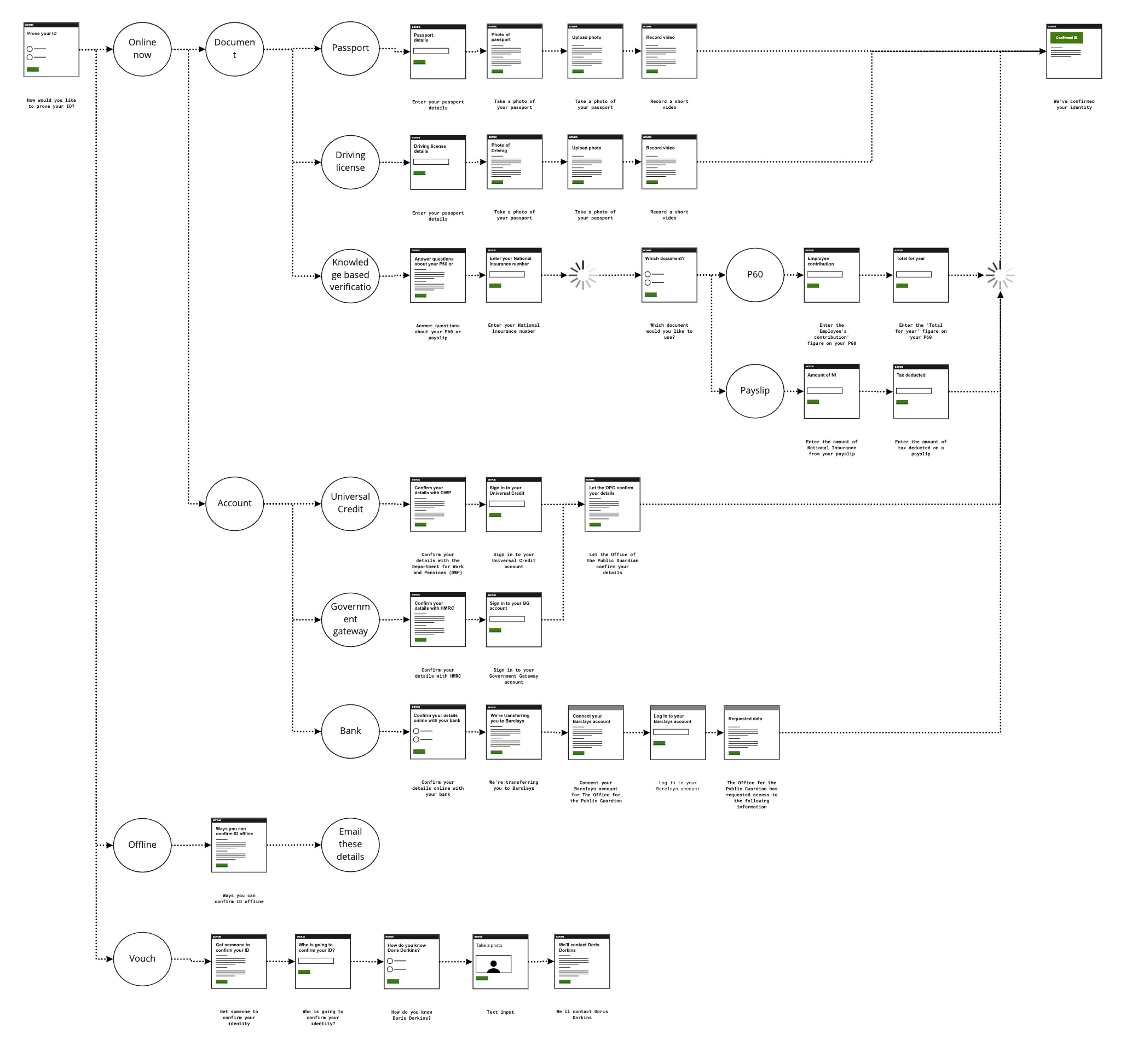
We iterated a number of times on the design and identification methods, testing each iteration with users.
The final version I designed and prototyped used a pattern where the user selects which ID options they have available to them. The service then evaluates their options and takes them through the two options that give the highest assurance according to GPG45.

Inclusive identity options
The main objective of this identity work is to provide an inclusive set of options so that every person has at least one means of being identified successfully. It is possible that some people won't have a driving licence, won't have a valid passport, won't do online banking etc. so we included an option to get someone within a list of professions to vouch for you.
Offline options have also been included for users with lower digital literacy, who might prefer to use the paper process.
Identity iteration
During my time on the project, I designed ten iterations that we tested with users. Here are some screenshots from four of the versions we tested:


Prototyping
For each iteration, I built a hi-fidelity prototype in code using the GOV.UK Prototyping Kit.
Here's a video of a possible journey through our latest prototype:
Testing with users
Every one of the ten iterations was tested with users. Because the aim was an inclusive service, we didn't test with a general sample and hope it worked for everyone. We recruited people who are most likely to be failed by online identity checks, and treated their experience as the benchmark.
Who we tested with
- Older people, who may be less confident with digital services and less likely to hold a current passport or driving licence.
- People who use English as a second language, to check that the content, instructions and ID choices were clear without relying on fluent English.
- People without the technology or documents that most ID checks assume, such as a smartphone, online banking, photo ID, or someone in their life who could confirm their identity.
What we learned
One key learning what that no matter how many different options we provided to verify identity, there would always be someone who would be excluded from the service:
- Not everyone has a passport
- Not everyone has a driving licence
- Not everyone has a bank account
- Not everyone has a government gateway account
- Not everyone uses the internet
- Not everyone has access to technology
For this reason, we needed a couple of lowest common denominator options. These were the vouching journey and the verify your identity in person journey. These options made the service just about as inclusive as it could be.
These findings shaped the final pattern, where users select the ID options they have and the service guides them through the two strongest routes. Nobody has to start with a method they can't use. The vouching option and the offline route exist because people in these groups told us, and showed us, that the digital-only options left them out.
What this work didn't cover
This was alpha, so we tested prototypes rather than fully developed solutions. They hadn't been built to meet WCAG standards, and accessibility testing with assistive technology was planned for private beta. The alpha work was about proving the approach was inclusive in principle and working out which design decisions to take into beta.
Outcomes
This work was part of the Modernising Lasting Powers of Attorney project. The service passed its alpha assessment and moved successfully into private beta.
The vast majority of people who make lasting powers of attorney are digitally literate and have access to the internet. Of this demographic, participants tended to choose the passport and driving licence routes. These were perceived to be the simplest options for them.
Design decisions validated:
- All participant will find at least one viable route to proving their identity
- Passport and driving licence will be perceived as the easiest options for most users
- The open banking option will cause some uncertainty/anxiety
I designed and prototyped all ten iterations that shaped the options and left the team with a tested, evidence-backed pattern for inclusive identity checks.